

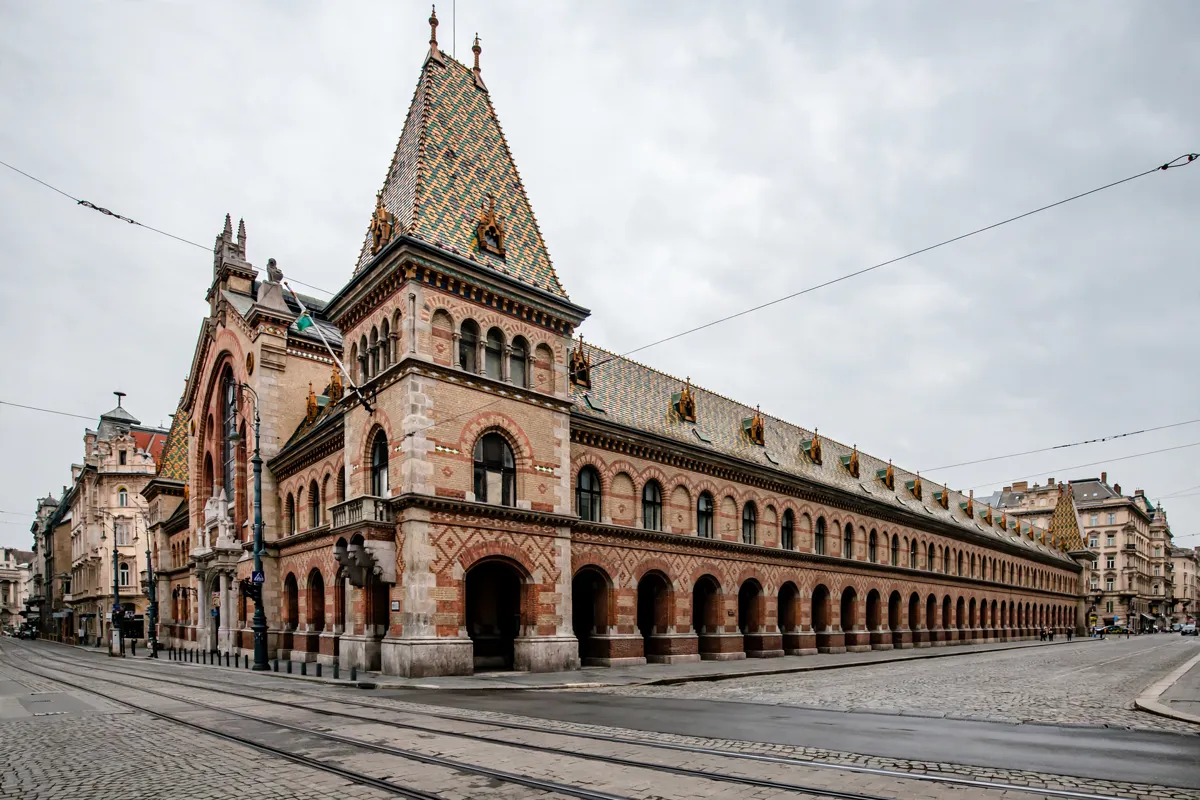
What You Will Find at the Great Market Hall
The Great Market Hall is officially listed as the Central Market Hall, at 1093 Budapest, Vámház boulevard 1–3. The operator describes it as a protected monument.
Its origins are tied to a citywide effort to modernize and secure Budapest’s food supply: the market-hall system brought together one central distribution hall and four retail halls under a municipal Market Hall Committee. Regular public-health checks of produce formed part of that system.
Food inspection was also built into the original purpose of the hall. One objective of the plans was to ensure that only inspected food was sold there. The building itself combined steelwork made at Schlick’s iron foundry with coloured ceramic components produced by the Vilmos Zsolnay company.
The city’s general assembly accepted a proposal to implement Samu Pecz’s design on 21 February 1894. A fire damaged the nearly completed building on 30 July 1896. Traders could sell in the hall from 1 February 1897, according to the operator’s history.
Its account gives an official opening date of 15 February 1887, but that year conflicts with other historical accounts and the surrounding chronology. A historical study instead says five Budapest market halls, including the Central Market Hall, opened in February 1897, giving 16 February as the date in its English summary.
The hall suffered significant damage during the Second World War. Renovation lasted from 1991 to 1994. These layers of practical history help explain why the building is both a working market and a protected monument. If you are planning a separate stop at another landmark, this guide to visiting St. Stephen’s Basilica covers that visit.
Opening Hours and the Best Time to Visit
Admission to the Central Market Hall is free, so you do not need a ticket for entry. The operator’s pages give conflicting opening hours. One lists Monday to Friday 06:00–18:00, Saturday 06:00–16:00 and Sunday 10:00–16:00.
The operator’s separate English schedule lists Monday 06:00–17:00, Tuesday to Friday 06:00–18:00, Saturday 06:00–15:00 and Sunday closed. The hall is also listed as closed during public holidays.
With Sunday hours in particular differing between the two schedules, avoid building a tight plan around a single listed time. Check the official site before you go.
The hall also hosts National Days, a recurring program created by the Hall and Market Management of the Municipality of Budapest. It usually runs from spring to late autumn, but there is no fixed schedule or stated number of events per year.
Each participating country’s program lasts three days, so this is an occasional addition to a market visit rather than something to count on for a particular date.
When a National Days program is taking place, it can include food and drink, souvenirs, traditional clothes and goods, dance shows, book presentations and musical performances.
Participating countries vary; examples listed by the operator include Japan, Bulgaria, Transylvania, Poland, Peru, India, Portugal, Croatia, Indonesia, Persia, Morocco, Tunisia, Egypt and Madagascar. Performances are usually organized by the participating country’s embassy after consultation with the market-hall operator.
Food, Produce and Souvenir Stalls
The market’s food focus is part of the original plan for Budapest’s market-hall system, which aimed to modernize the city’s supply and have food inspected. The available facts do not specify the current range of produce, prepared food or souvenirs, so it is better not to plan around a particular stall or product.
National Days offer a different reason to browse when they happen: participating countries may present food and drink, souvenirs, clothing and other goods alongside cultural programming. The country and activities change, and the program does not follow a fixed annual schedule.
For a visit without a National Days event, the hall’s address and free admission make it straightforward to add to a day spent around central Budapest without needing to book a ticket.
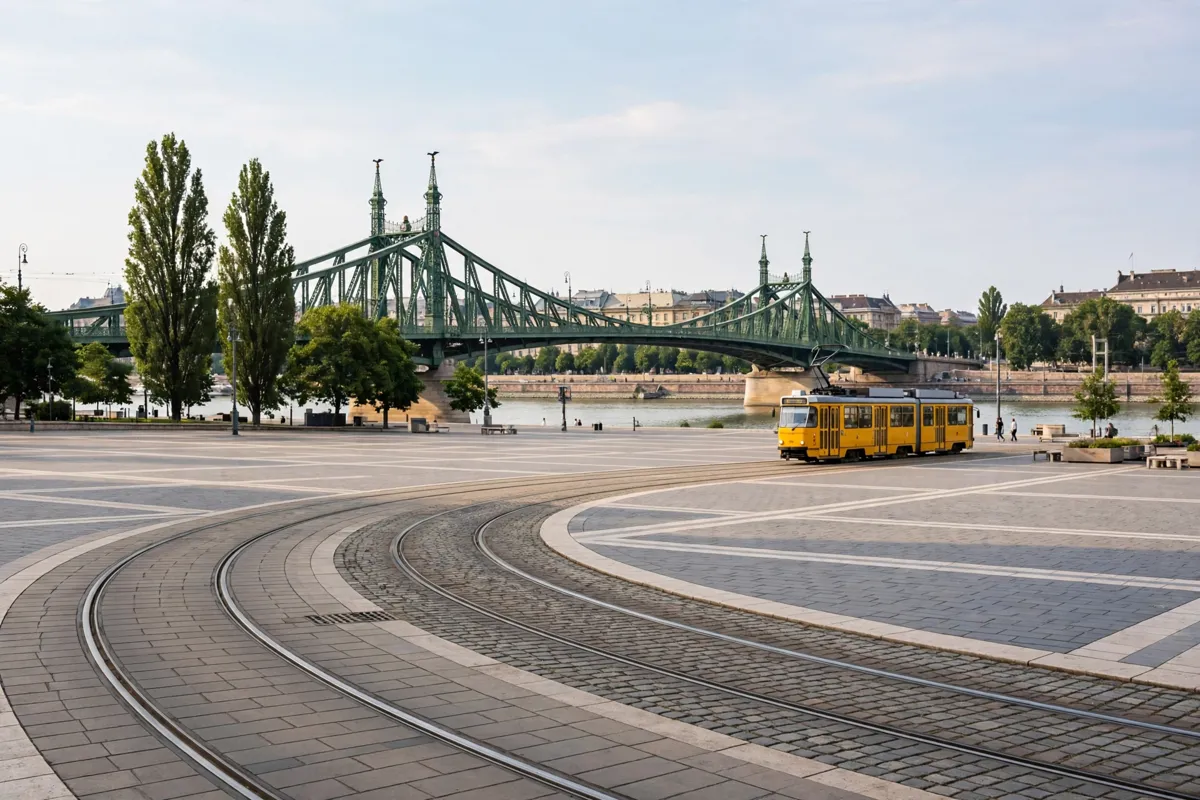
Getting There by Tram, Metro or on Foot
The operator lists tram lines 47, 47B, 48, 49 and 2, trolleybus 83, buses 15 and 115, and metro M4 as ways to reach the hall. Check the route that best fits where you are starting; this Budapest public transport guide can help you compare metro and other city transport options.
Parking is listed in surrounding streets, including Sóház street, Pipa street and Csarnok tér. If you are staying at Paulay Downtown Apartments, the hotel is in central Budapest and can serve as a base for a city outing.
You could pair a market visit with another Budapest stop, such as St. Stephen’s Basilica, using the linked guide to plan that visit separately.